We’re doing a late post to say thank you and farewell to our Roselani Summer Intern Ani. Ani is well on her way in her most recent semester in the Library and Information Science and Museum Studies Programs, but we miss her dearly. We had her update some questions for an exit interview, to help share her experiences with us as an intern and highlight some of the work being done in ʻUluʻulu.
Could you share a little more about the work you did at ‘Ulu’ulu since we did your last interview? Did your assignments change over the time you were with the archive?
A few things have changed since my last interview. I finished all of the projects that I was working on so I was given even more projects to work on. I finished doing the quality control and technical descriptions for the Don Ho collection, Juniroa Productions/ KGMB, Clear collection, and I finally got through the Nā Maka o Ka ʻĀina collection. I finished all the KGMB ENG Logs that were originally given to me and the extras I was given after. As for the Pau Hana Years Collection, I have turned my transcriptions into formatted captions, and finally aligned those captions to the audio with Aegisub. As for the cataloging and description work, I have also finished the Hawaiʻi Home Movies, on top of the Tūtū Ruth collection and the Juniroa/KGMB files.
You got to work on both transcription and descriptions for various collections; did you have a preference between the two? Why? Was there anything surprising or interesting about working on these aspects of moving image archive work?
This is a super good question and a hard one since I enjoyed both. I enjoyed doing descriptions for videos that included a lot of dialogue, like the Happy Birthday Tūtū Ruth sub-collection. I enjoyed listening to Tūtū Ruth’s insight and also her family’s interviews as well. However, the Hawaiʻi Home Movies on the other hand, were silent. It was interesting to see how Hawaiʻi looked like in the past, but it was still a silent video. As for the transcriptions and captioning, I found it to be very satisfying and full circle that I go to turn the transcriptions into actual captions on the videos. It was also very interesting to learn what is considered to be ADA compliant for videos and the process of captioning.
Now that you have worked as a Moving Image Archivist, and have had a chance to work with some different formats, what is your favorite archival media format and why?
This is also a really good question. I honestly feel like I am shifting away from film and more towards betamax, betacam, and ¾” U-Matic, just because those were the main types of media that I was able to work with. Though there were some 16mm and 8mm film that I was able to review.
Do you have any recommendations for movies or TV shows that feature libraries, archives, or archival footage? Any other last thoughts?
Well one TV show that I want to watch is “For All Mankind.” In one of our many discussions of TV shows and movies, Janel mentioned that she was watching the TV show, “For All Mankind” on Apple TV. The show explores the possibilities of what might have happened or existed if Russia had won the global space race and they used archival footage to adjust the footage of Russia landing on the moon first. I personally haven’t watched the show but it’s on my watchlist. Sadly, I don’t have Apple TV, but if and when I do get it, I look forward to watching that show.
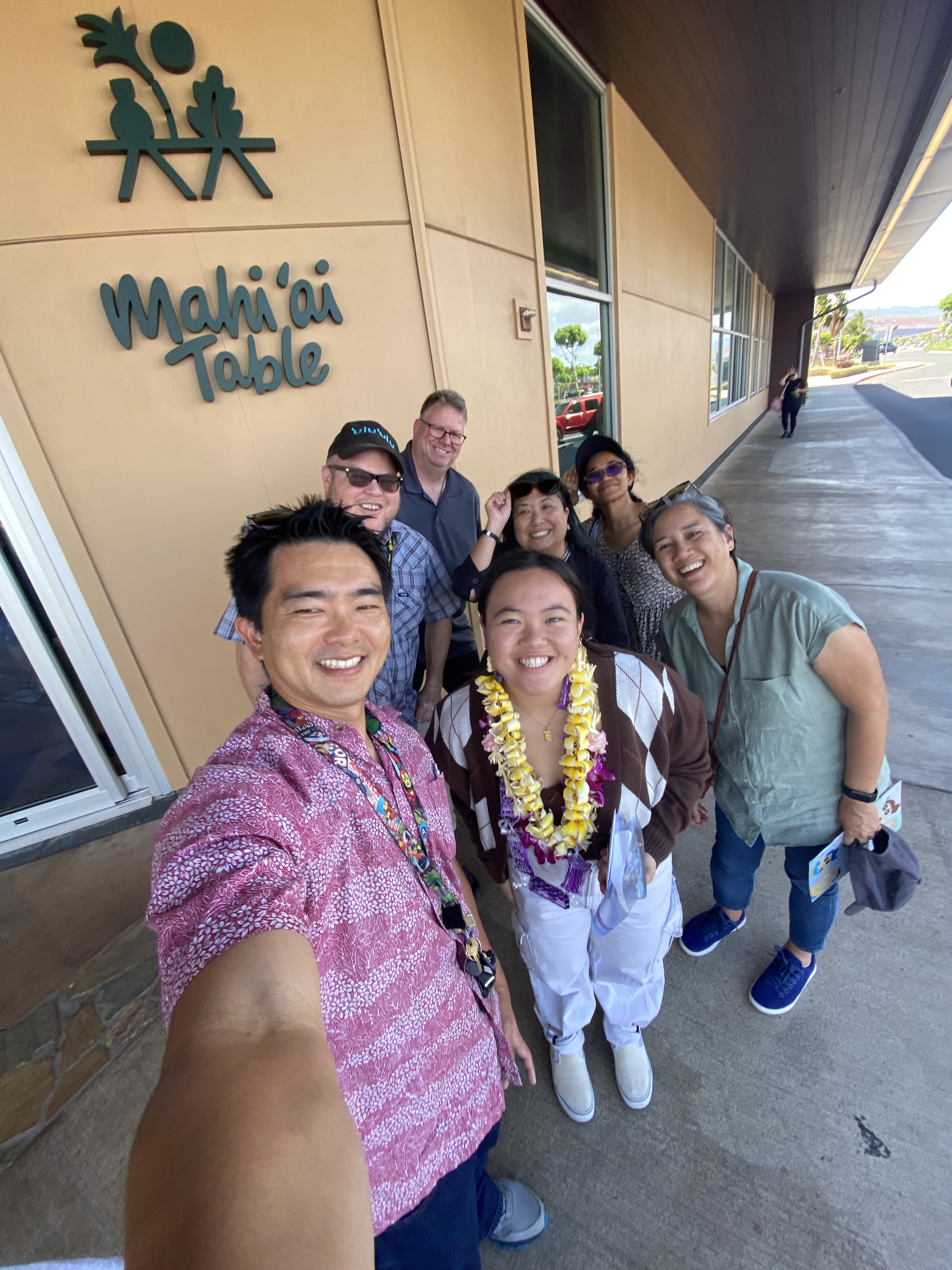
Thank you for your hard work this summer, Ani! We truly appreciated everything you brought to the table, and we loved having an in-person Roselani Intern again!
Through the generous support of the Henry Ku‘ualoha & Muriel Roselani Giugni Fund of the Hawai‘i Community Foundation, the Roselani Media Preservation Internship is offered each year at ‘Ulu‘ulu to give a student of merit who is committed to the preservation of our media history the opportunity to acquire practical experience in a moving image archive.
This semester we recently wrapped up our time with GBH Fellow and Intern Kimo Nichols. We were lucky to have him on our team for two semesters, as opposed to our usual one with standard interns. The GBH Fellowship that Kimo was part of allowed us more time together, and more opportunity for Kimo to learn about what we do at ʻUluʻulu. We hope it was inspiring for him, and plants a seed in him to stick with media librarianship or archives! We asked Kimo to share some closing thoughts with us in the following exit interview. Thanks for everything, Kimo! We’re sad to see you go, but you will always be part of the ʻUluʻulu Family!
Could you share a little more about the work you did at ‘Ulu’ulu since we did your last interview? Did your assignments change over the time you were with the archive?
Since the last time I checked in, I’ve continued to work on digitizing, creating metadata and writing descriptions for the raw interview footage of the Biography Hawaii series, which originally aired on Hawaii Public Television in the early 2000s. My work on this project didn’t change much over the course of my time at ‘Ulu‘ulu, but I honestly didn’t mind. It was rewarding work and I appreciated getting to hone my skills through repetition, rather than having to “jump around” from task to task. Personally, I learn more effectively this way, so I’m glad my work on this project took this path.
Was there anything about the material you worked with that was surprising or unexpected?
By far, the biggest surprise that I encountered was the amount (not a ton, but enough to be very interesting and entertaining) of potentially regrettable comments made off camera by both film crew personnel and interview subjects. These comments, largely uttered in innocence 20+ years ago when the footage was shot, were, of course, caught by a “hot” mic and saved for posterity for an archives student to hear 20 years later. Additionally, I came across some seemingly off-color comments made in an interview about some of our more recent historical figures; these were wisely left on the cutting room floor by the filmmakers, in my opinion. After talking to others in the archival field that have previously worked with raw interview footage, I learned that “bloopers” of this sort are actually captured accidentally quite a fair amount. It’s just one of the aspects that makes this kind of archival work both fascinating and fun, however it’s also obviously an ethical/legal challenge that an a/v archivist must deftly navigate!
Now that you have worked as a Moving Image Archivist, and have had a chance to work with some different formats, what is your favorite archival media format and why?
I worked strictly with Betacam SP tapes during the Biography Hawaii project at ʻUluʻulu, so I can’t offer any kind of an opinion on the pros and cons of this type of video tape media versus any other. Overall though, I was glad that I got to work with Betacam SP because it’s a format that I had never before encountered. Having grown up during the golden age of VHS, I had lots of personal experience with that format, so I have to say that I was pleasantly surprised by what seemed to be the superior picture and resolution offered by Betacam SP over what I remember of the good ol’ VHS tape.
Do you have any recommendations for movies or TV shows that feature libraries, archives, or archival footage? Tough question. Recommendations for movies featuring libraries and/or archives? I’m embarrassed to say that I had to go to the IMDb to think of any. I found quite a few that look interesting, but I’ve seen none of them to date. (Yep. This obviously means that I have not seen any of the Harry Potter films). In the “featuring archival footage” category, though, Zelig is definitely the first film that comes to mind.
ʻUluʻulu has been brimming with interns lately! We are lucky that this Spring Semester we have both Kimo and now, our first Library and Information Sciences intern in several years, Kate Marsi! We’re doing our usual welcome interview with Kate a little late in the semester, but we still have a few months left with her and still want you to know about her. Read more about Kate’s experience with us, below.
Tell us a little about yourself, Kate.
I am currently in my second year of the LIS program, and am studying in the archives and special collections pathway. Before entering the University of Hawaiʻi at Mānoa Library and Information Sciences program, I received my BA in East Asian Humanities from San Francisco State University and worked in education in the states of California and Washington. I am the student assistant du jour with the Jean Charlot Collection at Hamilton Library, and I aspire to continue to work in art libraries, museum archives, and other special collections after graduating from the program. I read ravenously, adore cinema, traveling, and fashion. I enjoy cooking and hosting dinner parties, and occasionally rec dive with my husband.
What brought you here to ‘Ulu‘ulu? What are some of the things you’re hoping to learn during your internship with us?
I took the course, “Moving Image Archives”, that Janel taught over the summer, and it left me wanting to learn more and take on some hands-on experience of working with film processing and preservation. I am hoping to learn more about handling and processing film, as well as how moving image archives systems differ from more “traditional” archives.
What projects are you working on at ‘Ulu‘ulu?
I am currently doing a good deal of work with the Hawaiʻi Home Movies Collection. I have been working on quality control of access files for newly digitized materials, and assisting with inventory, inspection, and condition reporting of two boxes of film from another family that has donated home movies to the collection.
Is there anything about the items you are working with that is surprising or unexpected?
When handling film in person, I was not ready for the realities of degrading film. I have had the pleasure of processing some yucky papers with my work at Jean Charlot, but the smell of vinegar syndrome and film decay was a massive shock. Definitely not a smell I will ever forget. On a less gross-out note, I have enjoyed the unexpected reality of being able to see these vignettes of everyday life in Hawaiʻi while working with the Hawaiʻi Home Movies Collection.
Now that you’ve been at the archive for a little while now, have you found a favorite aspect?
I have really enjoyed processing the Wadsworth collection. It has allowed me to get hands on, and become familiar with the different formats of film and see first hand how to determine a film reel’s condition when it arrives at the archive.
Do you have any advice for future ‘Uluʻulu interns or fellows?
Kate decided to wait on this until she made it further into the semester. We’re counting on her to double back and fill us in. Check back with us, later!
As we announced earlier, our newest team-mate is Kimo Nichols. Kimo is our Public Broadcasting Preservation Fellow. We’ve asked Kimo to fill out our introductory interview so you all get to know him a little better. Dive in below!
I grew up on Oʻahu, attended local public schools and graduated from UH-Mānoa with a B.A. in American Studies and a Certificate in Ethnic Studies in 1993. I currently work in the Serials Department at Hamilton Library and am now working on my MLIS degree. In my spare time, I do a reggae show on KTUH FM and enjoy collecting vinyl, listening to music, watching football, hiking and spending time with my family.
What brought you here to ‘Ulu‘ulu? What are some of the things you’re hoping to learn during your internship with us?
I’ve been interested in audio/visual related archives for a while now and had the great fortune to previously work in one at UH-Manoa: The Wong Audiovisual Center located at the former Sinclair Library. I was brought to ʻUluʻulu through the University of Hawaiʻi at Mānoa’s MLIS program, where I learned about the Public Broadcasting Preservation Fellowship that was available through the American Archive of Public Broadcasting. I was extremely fortunate to be awarded a fellowship for the current academic year and placed at ‘Uluʻulu to serve my internship.
While at ‘Uluʻulu I look forward to learning as much as I can about video digitization and archival descriptive cataloging practices.
What projects are you working on at ‘Ulu‘ulu?
At the moment, I am working on digitizing and writing cataloging metadata descriptions for raw video footage of episodes in the Biography Hawaii series. So far I have digitized Betacam SP tapes and written metadata for episodes focusing on kumu hula Maʻiki Aiu Lake and union/civil rights attorney Harriet Bouslog.
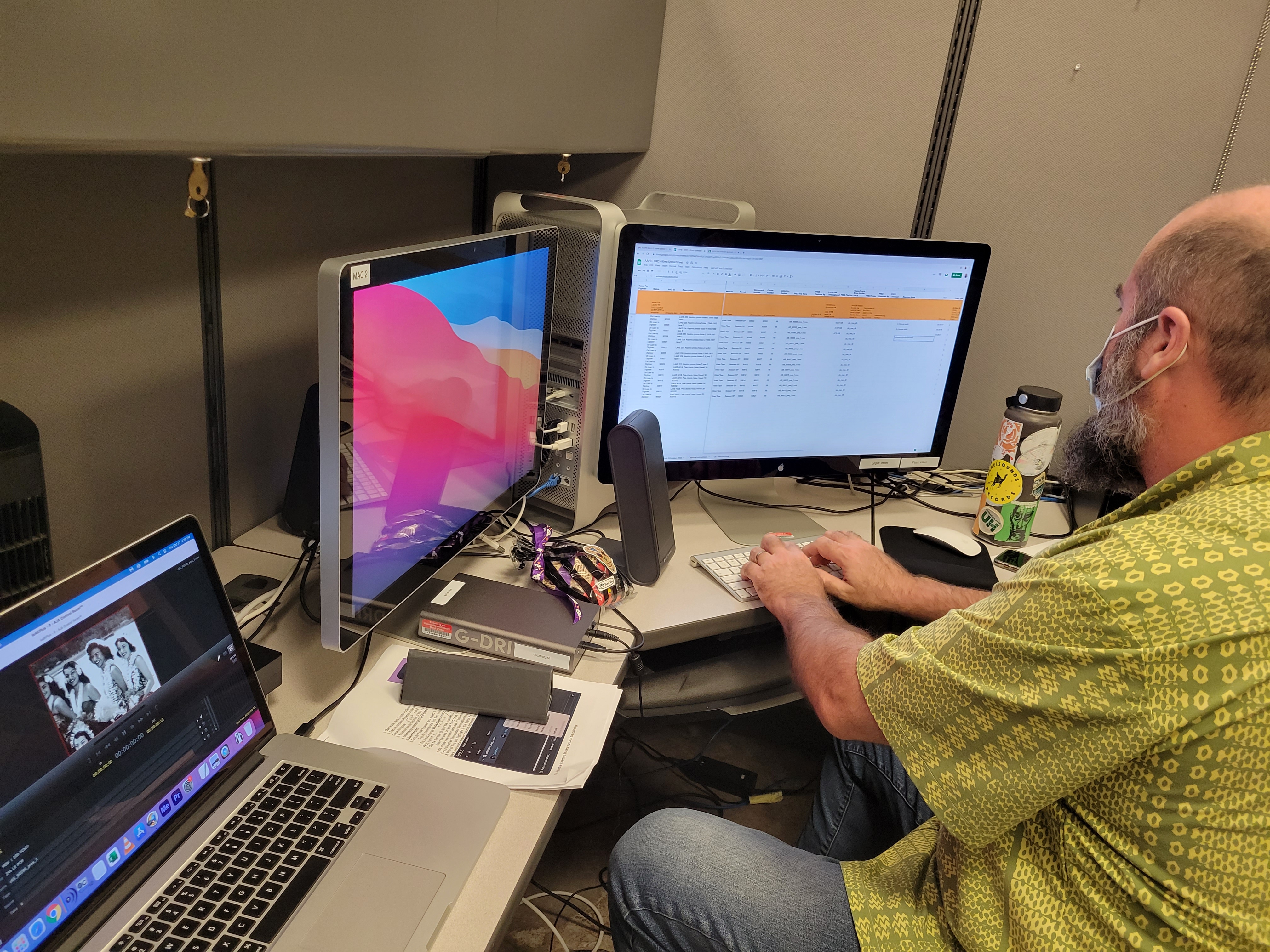
Kimo reviewing tapes from the Biographical Research Center Collection.
Is there anything about the items you are working with that is surprising or unexpected?
Actually, quite a lot of what I’m working on has been unexpected, due mostly to my own ignorance of the historical subject matter. I had never heard of Harriet Bouslog before working with the Biography Hawaii footage, let alone Hawaiʻi labor movement icon Ah Quon McElrath, the main interview source for the episodes on Bouslog. Similarly, although I have a bit more knowledge on the subject of hula, the many hours of footage and interviews I’ve digitized on the life and impact of Maʻiki Aiu Lake have been completely revelatory. Getting to hear the expertise and candor of hula and Hawaiian cultural authorities such as Robert Cazimero, Kalena Silva and Puakea Nogelmeier reminisce about Maʻiki and break down her hallowed place in the Hawaiian renaissance has been both fascinating and entertaining.
Now that you’ve been at the archive for a little while now, have you found a favorite aspect?
Apart from being fortunate enough to benefit daily from the kindness, patience and amazing expertise of the staff, I’d say my favorite aspect of interning at ʻUluʻulu is being able to soak up as much as I can of all the incredible stories, history and images available in its archives. I’m being allowed to work with materials that really broaden and further my perspective of Hawaiʻi and its peoples .
Kimo hard at work in the digitizing lab.
Do you have any advice for future ‘Uluʻulu interns or fellows?
My advice would be to really just soak it all in and enjoy every moment of the learning experience. I think that if future interns keep an open mind, love learning and show respect to the materials, interning at ‘Uluʻulu is an incredibly rewarding opportunity to work with an amazing group of people all committed to helping make sure Hawaiʻi’s story is told through the preservation of moving images.
One of the many projects that our Roselani Intern, Lily, has been working on is the enhanced descriptions of some of our news tapes.Since she is doing her work remotely, she is doing a lot of learning about Hawaiʻi without the benefit of being in the archive to chat with all of us in person. However, through her communication with us over email and through meetings and through the mountain of material she’s been working on during her internship, Lily has been getting a real crash-course in Hawaiʻiʻs more recent history. During her hoursof research and viewing, she has found some topics have stood out to her as particularly impactful. Read on to see what caught Lily’s attention this summer.
One thing I’ve really enjoyed during my internship this summer is how many opportunities I’ve had to learn more about Hawaiʻi’s history through the various collection footage I’m going through. In particular, there was one recurring piece of history that I found significant to gaining a deeper understanding about the relationship between the State and Native Hawaiians in the 1980s — the events of Sand Island.
What I found while watching the news segments on Sand Island in the KGMB Electronic News Gathering (ENG) File collection, and then comparing it to Victoria Keith Productions‘ The Sand Island Story — a documentary filmed at the same time — is that the news withheld a lot of information which, in turn, negatively framed Sand Island residents as squatters and derelicts.
The news segments from November 1979 through January 1980 follow the efforts of the Sand Island residents as they attempt to negotiate with the State and Governor Ariyoshi on their decision to turn Sand Island into a State recreation area and evict the community that had built their homes on the shoreline.
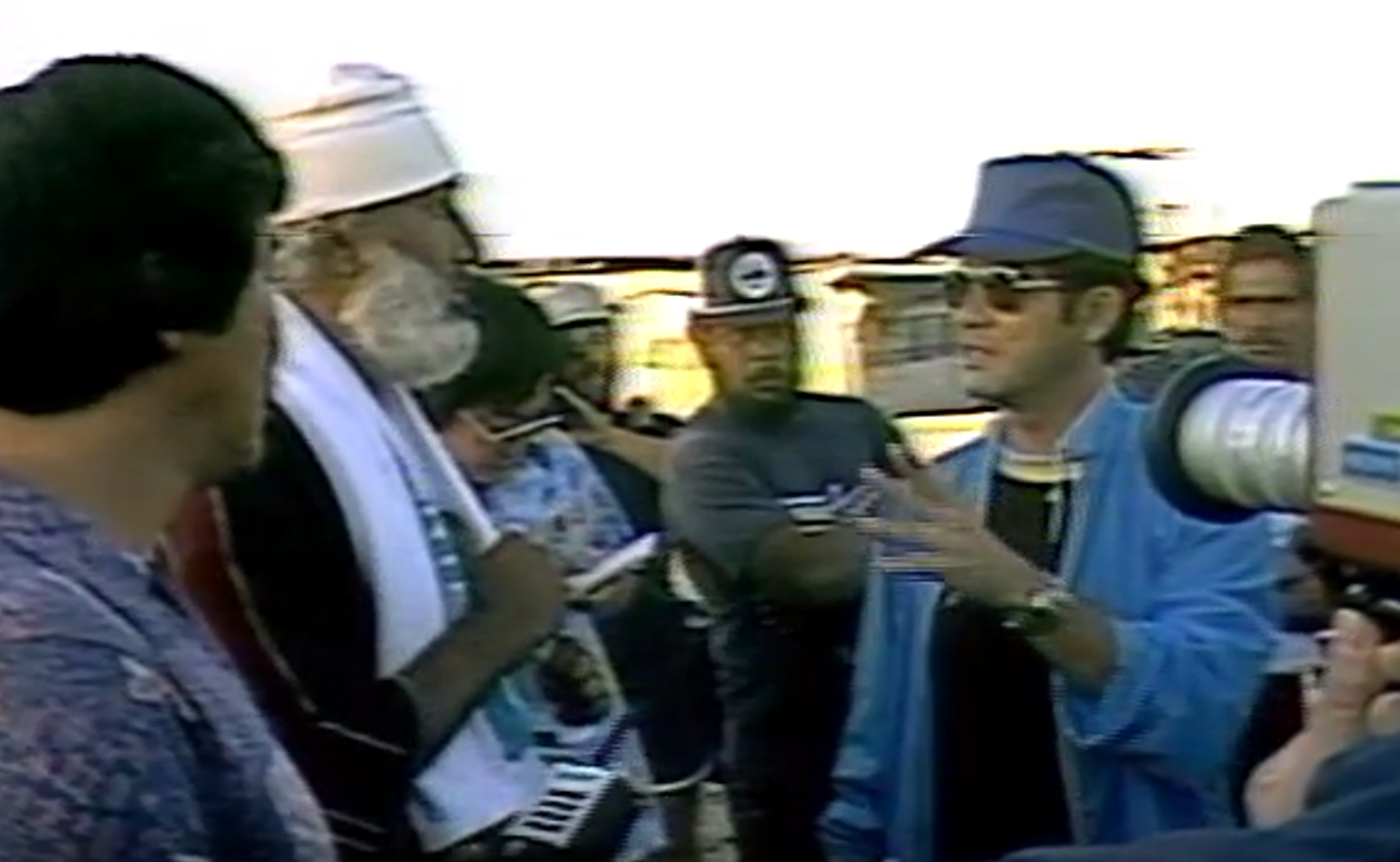
Abraham “Puhipau” Ahmad talking to State Officials about the bulldozer blockade at the settlement.(KGMB ENG #58)
A primary difference that I observed was how the footage and interviews with Sand Island residents, such as Abraham “Puhipau” Ahmad, are filmed and presented in both the documentary and news segments. The KGMB news segments manage to capture the frustration of residents and highlight their inability to move to another home — but they conveniently fail to mention why most people living on Sand Island are unable to find a new residence; which was largely due to unreasonable housing costs and arbitrary evictions that pushed many Native Hawaiians out of their homes. One couple in the documentary even mentioned that their names had been on the list for housing since 1949 — at the time of filming they had already waited 30 years.
It appears that the only time the news focuses on the efforts of Sand Island residents to compromise with the State are during ENG File #56, where the community has proposed a cultural park that preserves the Native Hawaiian lifestyle and allows for combined public use and resident living. Unfortunately, as mentioned by the reporter, the State refused every request for a meeting between the parties. Personally, I feel that the lack of information about the Sand Island residents’ attempts for compromise contributed to the negative image the Sand Island community had on the news. It’s unfortunate because the documentary emphasizes the efforts the residents made to create a cultural space to pass down Native Hawaiian traditions. An interviewee in the documentary even points out that the news makes them out as squatters who want a free place to stay, but they have knowledge and desire to pass down Native Hawaiian traditions and culture.
Another thing I noticed after watching the documentary is the information the news does not include. Important contextual information about the history of Sand Island is absent from the news segments which only further frames the Sand Island community negatively as squatters and illegal tenants. Although at this point I feel that it should be noted a major benefit that I have which the employees and public viewers of KGMB news in 1979 did not have: access to the World Wide Web — which has vastly changed the way we receive our information.
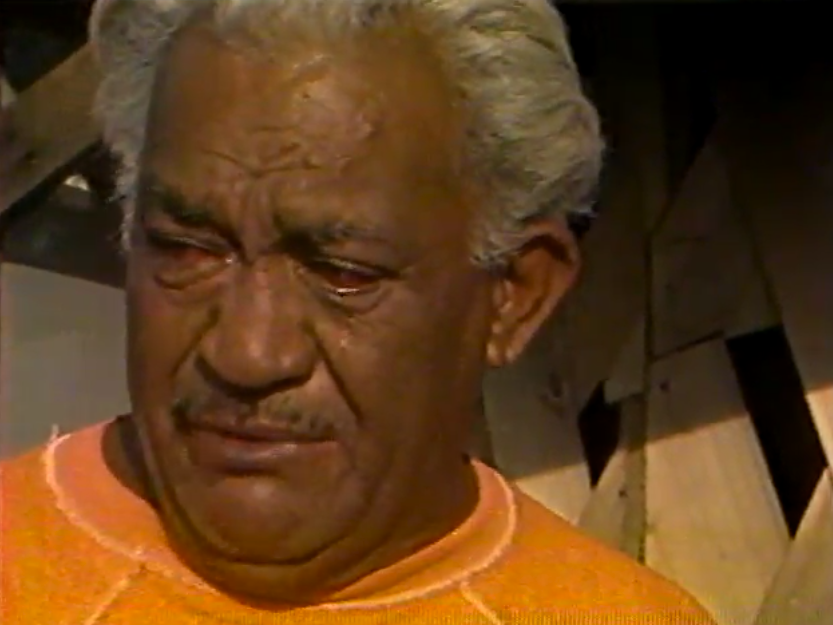
Clement Apolo reacting to the bulldozing of the Sand Island settlement in Victoria Keith’s “Sand Island Story.”
A quick search of the island’s history is this: Sand Island, originally nicknamed “Quarantine Island” in the 1800s because the area was used to quarantine ships that carried contagious passengers. It was then used as an internment camp during World War Two for primarily Japanese-Americans until 1943. After the war, the neglected space was used as a dumping ground and until the 1970s when there was a cleanup effort by Native Hawaiians — who built homes and cleared away the waste on their own volition.
It was then that the State reclaimed this land for industrial and recreational development, and in fact, it was only once the State decided to reclaim the land that the community was legally declared squatters on state land.
Arguably, the absence of this information in the news cycles at that time made it easier to convince the public that the residents are taking advantage of the State, while in fact they were still paying taxes while living on Sand Island.
Comparing footage from the day of demolition on the homes, there’s a disconnect watching the residents on the news and in the documentary. Peaceful protests are not depicted in that way and the news footage captures the anger and hurt of the residents, yet because of time limitations, the full story cannot be told. One clue that indicates that the news may be presenting the story more one-sided is the involvement — or refusal — of parties outside of the Sand Island community. Both ENG Files #57 and #58 have segments that comment on the outside groups that are in support of the residents. ENG file #57 mentions various activist groups that have joined to protest the eviction –which included People Against Chinatown Evictions, Waiāhole-Waikāne Community Association, Ota Camp, and the Revolutionary Communist Party; and in ENG file #58, a bulldozer operator leaves the job the day that demolition is set to begin. While I can only speculate, I still believe these two segments hint at a larger public concern and engagement than the news was able to broadcast.
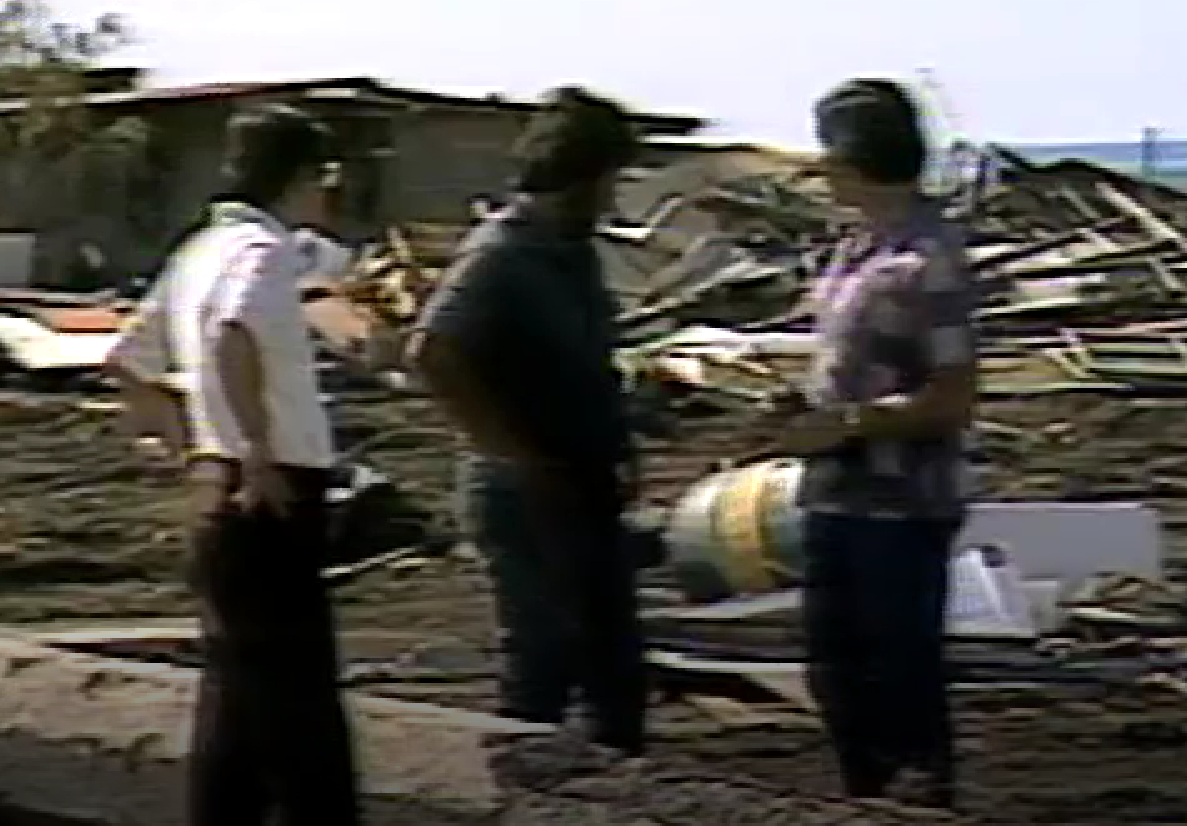
After a bulldozers showed up at 6am to begin demolishing abandoned structures, residents attempt to prevent bulldozing to ensure their homes will not be destroyed. One bulldozer operator left job due to personal feelings on the matter. (KGMB ENG #58)
As ubiquitous as the Sand Island eviction story was for four months on the news, it seems to end with no resolution. In ENG File #73, February 25th, 1980, a solo interview with Abraham Ahmad, “Uncle Puhipau,” outside of the ʻIolani Palace, where he discusses how their option now is to charge the State for breach of trust and bring the attention of the 5F issue to the U.S. Attorney General. ENG File #74 shows a legislature meeting with local community members while they voice their concerns, but the outcome is unclear.
To my knowledge and from what I’ve been able to determine from research, ultimately the space was not developed the way the State intended when they evicted the residents, and there is still trouble in determining its function; ironically an article from 2014 speaks about a proposal for a homeless shelter in the Sand Island State Recreation Area, featuring facilities and housing which would temporarily abade the homeless crisis. I’d be curious how the Sand Island State Recreation Area is used today, and what is and is not included in whatever history of the land they might share in the visitor’s center.
It’s important to keep in mind that KGMB news did not have the same ability to see a broader outline of the events that led up to the State’s reclamation of the land as I did; nor could they have known the failed outcome. The segments tended to frame the conflict with the State in the more positive light. However, it appears evident in the footage that the reporters were making the effort to interview residents for their side of the story.
After seeing how drastically the narrative of the Sand Island community can be transformed through the absence of crucial information, I am even more convinced that it is essential to be able to save and preserve as much history as possible from local filmmakers and creators; the ability to see multiple sides of the same story paints a fuller picture. In fact, TheSand Island Story has hours of RAW footage that wasn’t included in the final cut that I’m very interested to check out; especially when the internet doesn’t yield many results on the residents’ side.
The HKG Archive undertook a comprehensive search for vendors that will be used for the preservation and digitization work in the Pilot Project. Proposals were obtained from Bay Area Video Coalition, and D. C. Video, both in California, and Scene Savers in Covington, Kentucky across the river from Cincinnati. All three submitted excellent proposals. Based on these proposals I would not hesitate recommending any of these companies for future work.
However, in the end we could only select one, and I am happy to inform you we we selected Scene Savers. They were the only company that could handle all the the formats we are looking to preserve in this Project in-house. John Walco, from Scene Savers, will be coming to conduct a media digitization/ preservation workshop in August. More information about the workshop will be posted soon.









 ʻUluʻulu: The Henry Kuʻualoha Giugni Moving Image Archive of Hawaiʻi