Category Archives: Uncategorized

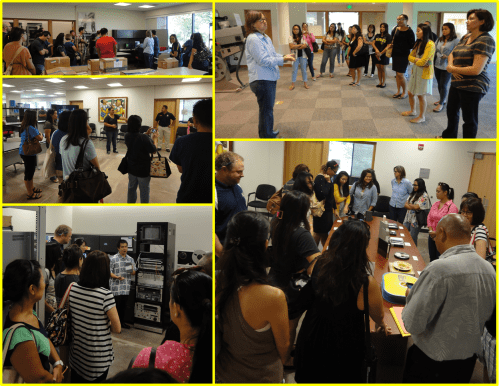
200 Waipahu High School Faculty & Staff Visit ‘Ulu’ulu

Mahalo Waipahu High School Faculty & Staff for visiting ‘Ulu‘ulu!

Heather welcoming our first group of Waipahu High School faculty & staff

Heather welcoming our first group of Waipahu High School faculty & staff

Yesterday, our ‘Ulu‘ulu crew hosted a series of archive tours for some 200 faculty and staff visiting UHWO from Waipahu High School. We enjoyed sharing about ‘Ulu’ulu and the work we do, shared an extreme example of preservation challenges in Hawai’i, and helped teachers find their place in the timeline of video formats – good good fun!

From all of us at ‘Ulu‘ulu, we extend a warm aloha to these awesome teachers for their enthusiasm and interest in Hawai‘i’s moving image history. Remember to visit our website at uluulu.hawaii.edu to begin searching our collections and integrating video of Hawai‘i’s history and cultures in your classroom. And, please feel free to contact our Reference Archivist, Shavonn Matsuda, with any questions, footage or visit requests.

Click to view more photos on our Flickr

Click to view more photos on our Flickr

View photos on our Flickr

AHA Repository Spotlight – Lyman Museum & Mission House

The Association of Hawai’i Archivists (AHA) is highlighting local repositories on its blog each month. This month AHA has chosen to spotlight a repository that was one of ʻUluʻulu’s partners in our HKG Pilot Project – the Lyman Museum & Mission House in Hilo, Hawaiʻi. AHA’s post details the museum’s Pierce Photo Identification Project which has helped Lyman to successfully identify about 450 of the almost 800 unidentified photos they’ve made publicly available. According to the post, the Photo ID Project is “a multi-pronged strategy to recruit community help to solve these mysteries.” Read more on AHA’s Repository Spotlight.

Two new faces at ‘Ulu‘ulu

We welcomed two new faces this month – Jonah Dias and Keahiahi Long.

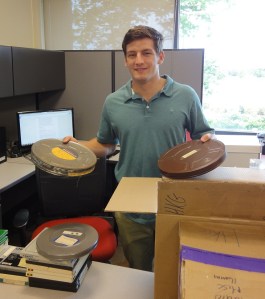
Jonah Dias

Jonah Dias


Jonah Dias is from Hilo, Hawai‘i and is a 2011 graduate of Kamehameha Schools Kea‘au. He is currently a senior in the Academy of Creative Media program at the University of Hawai‘i at Mānoa and hopes to work in the film industry after graduating with his B.A. Jonah says he is interested in film because he “appreciates learning from stories and sharing stories.” He shared that he’s happy to be at ‘Ulu‘ulu because he likes to learn about the history of Hawai‘i and its people and ‘Ulu‘ulu enables him to do so through film. When he’s not here at ‘Ulu‘ulu, Jonah also serves as a Production Technician for PBS Hawaii.

Keahiahi Long is from O‘ahu and is a graduate student in the Master of Library & Information Science program at the University of Hawai‘i at Mānoa. As part of her summer fellowship with the Dance Heritage Coalition (DHC), Keahiahi spent the first part of her summer interning at the Museum of Performance + Design in San Francisco. She will be fulfilling the DHC’s practicum requirement by working at ‘Ulu‘ulu for the next 6 weeks helping to research dance materials in our collections.

We are thrilled to have both Jonah and Keahiahi with us!

Archivist Picks: Wai ~ Water

Water is life… film as a tool for outreach on water struggles

Water is believed to be a physical manifestation of Kāne, who is considered one of the four major gods in Hawai‘i. In light of this spiritual belief, no one had ownership over water in traditional society, not even the ali‘i. Instead, laws were created to manage water as a community resource.

However, with the increased settlement by foreigners from 1778 onwards, water became a growing concern. Enticed by Hawai‘i’s location and climate, foreigners flocked to Hawai‘i to establish their businesses and sugar and pineapple plantations spread across the Islands. With the growing demand for water and irrigation, ditch systems were introduced to transport millions upon millions of gallons of water from windward communities to the plantations. For decades, water diversions for sugar interests have stunted native life and Hawaiian communities that rely on freshwater streams; as D. Kapua‘ala Sproat reminds us in Ola I Ka Wai: A Legal Primer for Water Use and Management in Hawai‘i, “pu‘ali kalo i ka wai ‘ole – taro, for lack of water, grows misshapen.”

Irrigation. Lyman Museum & Mission House subcollection

Irrigation (circa 1920s). Lyman Museum & Mission House subcollection

Fast forward to the 1990s… As plantation after plantation began to shut down, conflicts over the distribution and use of water were brought to the forefront. Issues of ahupua‘a management, particularly the importance of water for kalo farming and for the health of marine life and the environment overall, were raised by Hawaiians and interest groups who advocated for the restoration of streamflows.

Perhaps one of the most well-known efforts is the Waiāhole-Waikāne water struggle over the diversion of water from east O‘ahu after the close of Oahu Sugar. The Waiāhole-Waikāne case is important for Hawaiians and for Hawai‘i because it resulted in the first return of water to Hawai‘i’s streams. The case is discussed in numerous articles and publications, including a multivolume text, titled “A History of Water: The world of water,” which acknowledges the significance of this water struggle at a global level.

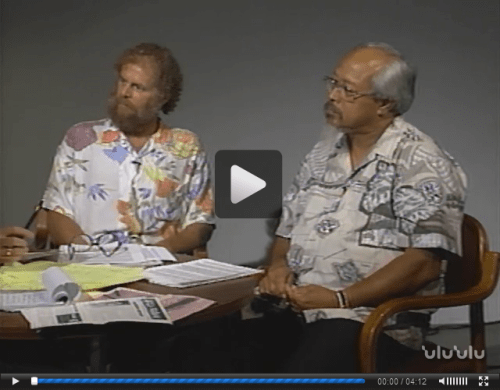
First Friday : The Unauthorized News : Waiāhole Water (September 1994). Kamakakūokalani Center for Hawaiian Studies subcollection

First Friday : The Unauthorized News : Waiāhole Water (September 1994). Kamakakūokalani Center for Hawaiian Studies subcollection

But, what’s noteworthy about Waiāhole-Waikāne (at least in relation to our work at ‘Ulu‘ulu) is the role of film in “providing voices and context for traditional Hawaiian water management” and subsequently educating Hawai‘i and the world about the importance of water:

“The internet has been an important means of disseminating information about the underlying basis for the windward position and updates on the status of the Waiāhole conflict… Other forums have also been used to address traditional Hawaiian ideas about water as they relate to the conflict over the waters of Waiahole and other windward O‘ahu streams… One of the most direct means of outreach, however, has been through the media of film. Movies with titles such as Ahupua‘a, Fishponds, and Lo‘i (1992), Hard Taro of Waiāhole (1995), and Stolen Waters (1997) were produced by the organization Nā Maka o ka ‘Āina [and]… underscore the need to let water remain in the streams of origin by providing voices and context for traditional Hawaiian water management. As a movie, its message has the potential to reach a diverse and wide audience within the archipelago, throughout the Pacific, and on the mainland.” – Oestigaard and Tvedt p. 45-46.

Thus, the appeal of film presented (and continues to present) a powerful medium for outreach on water. And, as evidenced by other films produced by Nā Maka o ka ‘Āina and others like Victoria Keith Productions, film (and video) provides an excellent medium for education about Hawaiian culture and for the issues facing our communities then and now.

Two Green Valleys (1976). Victoria Keith Productions Collection

Two Green Valleys (1976). Victoria Keith Productions Collection

The new theme on Water on our ‘Ulu‘ulu website includes footage from First Friday episodes with water resources researcher George Hudes and taro farmer Herbert Hoe from Waiāhole discussing the Waiāhole-Waikāne water case, water codes, the Water Commission, and the advantages of stream restoration. The theme also includes clips of a sugar irrigation system ditch, a Kaua‘i ditch (with footage of an interview on water rights), and a clip of what looks to be people working at the Waihe‘e Ditch.

Battles over water persist today. So, it is important to understand the history of water rights in Hawai‘i. Ola i ka wai, water is the life giving source!
View our Wai Theme here.

References:
Ola I Ka Wai: A Legal Primer for Water Use and Management in Hawai‘i, by D. Kapua‘ala Sproat.

Oestigaard, Terje and T. Tvedt, ed. A History of Water: The world of water, vol. 3. New York: Palgrave Macmillan, 2006.
Excerpts available on GoogleBooks: http://books.google.com/books?id=if5BWWiEhx8C&lpg=PA44&ots=QUBUEVy4xw&dq=waiahole%20waikane%20valley%20conflict&pg=PA45#v=onepage&q=media%20of%20film&f=false

Motion picture film projectors now on display!

Have you ever been inside a movie theater projection booth? If not now’s your chance to get a glimpse of some analog film projectors at ‘Ulu‘ulu!

Now on display inside the UHWO Library are two 35mm projectors and one 16mm projector that once screened films at the Hawaii Theatre. We took in these projectors from the Hawaii Theatre when they switched to digital projection in 2013 and are excited to share this celluloid technology with visitors to ‘Ulu‘ulu.

Mahalo to the Hawaii Theatre for donating the projectors; to Alan Sakaida from Consolidated Theatres for spending a Saturday at ‘Ulu‘ulu assembling them for display; and to the UHWO Facilities Crew for moving these 500 pound beasts into our exhibit area!!

~ Pictures featured above are of the Punahou PUEO Program students who stopped by today. Mahalo PUEO Program!

‘Ulu’ulu crew attends International Conference on Indigenous Archives, Libraries & Museums (Palm Springs, CA)

Palm Springs, California ~ sunny skies and 100 degree weather

Palm Springs, California ~ sunny skies and 100 degree weather

Two of our ‘Ulu‘ulu crew, Shavonn Matsuda and Koa Luke, attended the International Conference on Indigenous Archives, Libraries & Museums in Palm Springs, California last week. The annual conference is organized by the Association of Tribal Libraries, Archives, & Museums. It brought about 600 librarians, archivists, museum specialists, cultural practitioners and others from around the world together to discuss current challenges and successes related to developing and sustaining the cultural sovereignty of Native Nations. Topics included preservation, collections care, digitization, documentation, access protocols, project management, education, academic outreach, language revitalization, funding, and more.

Shavonn and Koa met people from all over, including Alaska, Canada, Washington, Wisconsin, Oklahoma, New Mexico, Washington D.C., California, and the Philippines. Shavonn even got to listen to a presentation by a Maasai woman who traveled all the way from her home in Africa to share about her tribe’s effort to create a Maasai Culture Heritage Center to “inspire the community to preserve indigenous knowledge for generations to come.”

This slideshow requires JavaScript.


Still, it wasn’t just ‘Ulu‘ulu that was in attendance from Hawai‘i… some of ‘Ulu‘ulu’s partnering institutions also attended and presented – Hula Preservation Society (Kahikina Whittle and Keau George), Office of Hawaiian Affairs (Kale Hannahs), Kamakakūokalani Center for Hawaiian Studies (Pi‘ilani Ka‘aloa and Kauwela Valeho-Novikoff), and Bishop Museum (Noa Dettweiler-Pavia) – along with other Hawai‘i organizations, like the Hawaiian Historical Society, Kanu o ka ‘Āina Learning ‘Ohana, Papahana Kuaola, and Nā Hawai‘i ‘Imi Loa. So, in addition to being able to share about all the awesome work being done here in Hawai‘i with others from around the world, the conference provided a chance for our ‘Ulu‘ulu crew to get together with representatives from these local organizations and talk story about the work we are doing and the importance of forums like these that engage information professionals and cultural practitioners alike.

And, Koa and Shavonn didn’t just attend and network at the conference, rather they took advantage of the opportunity to present about the work they do at ‘Ulu‘ulu, at the University of Hawai‘i, and in our communities.
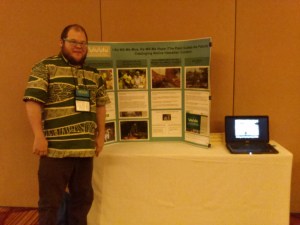
Koa Luke presenting his poster

Koa presenting his poster

Koa presented a poster titled “I Ka Wā Ma Mua, Ka Wā Ma Hope (The Past Guides the Future): Cataloging Native Hawaiian Content” covering the work we do at ‘Ulu‘ulu, mainly the creation of a Hawaiian Language Subject Index.

Shavonn co-presented two separate sessions. The first, “Ka Waihona: Repository of Ways of Knowing,” offered insights into how a modern special collection retains generations of ancestral ways of knowing and expands its offerings through ongoing knowledge generation.
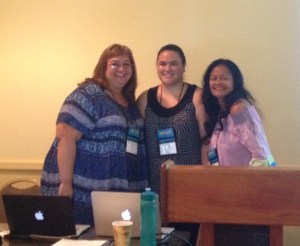
'Ulu'ulu's Shavonn Matsuda (middle) with co-presenters Pi'ilani Ka'aloa (left) and Kauwela Valeho-Novikoff (right) from Kamakakūokalani Center for Hawaiian Studies presenting on Waihona

Shavonn (middle) with co-presenters Pi’ilani Ka’aloa (left) and Kauwela Valeho-Novikoff (right) presenting on Waihona

The second, “Ho‘okele Na‘auao: Navigating Collaborative Partnerships to Advance Indigenous Stewardship,” detailed the goals, planning process, and challenges and successes of the Hawaiian Librarianship Symposium hosted by Nā Hawai‘i ‘Imi Loa, Kamakakuokalani Center for Hawaiian Studies, and the UH Mānoa Library & Information Science program last September; mainly focusing on the partnerships and collaborative tools that made it such a well-attended event.

During these presentations and throughout the conference, Koa and Shavonn connected with people working on similar issues across the globe and are hopeful that their expanded network (of friends and colleagues) will provide an avenue for support in the work we do at ‘Ulu‘ulu and the work being done in tribal and other indigenous communities. They also hope to be able to visit the awesome people they’ve met in the near future 😉 … and offer an invitation to each of them and to the ATALM community as a whole to visit us here at UH West O‘ahu anytime!

‘Aha Pūnana Leo Receives First Early Ed WINHEC Accreditation

Congratulations to the ‘Aha Pūnana Leo Hawaiian language nest preschools on their recent accreditation from the World Indigenous Nations Higher Education Consortium (WINHEC)!

As explained in the announcement of International Recognition for Hawaiian Language Preschools on the ‘Aha Pūnana Leo’s website,

“For 90 years the use of Hawaiian was illegal in schools. The ʻAha Pūnana Leo led the movement to remove that ban and has been the primary private entity supporting the development of education through Hawaiian from preschool on to the doctorate level. Language revitalization programs worldwide widely recognize the ʻAha Pūnana Leo as the model for education in an endangered and indigenous language revitalization movement.”

Receiving WINHEC accreditation is undoubtedly an important accomplishment for the ‘Aha Pūnana Leo in and of itself but it is also significant as this is the first time an early education program has received this international accreditation. In celebrating this landmark accomplishment as well as the 30th anniversary of the first Pūnana Leo preschool (started in 1984 in Kekaha, Kaua‘i), we’d like to share some footage from our collections which feature the ʻAha Pūnana Leo (and its Board President Dr. Kauanoe Kamanā).

Videos from the Juniroa Productions collection:

screenshot_title1164

Pūnana Leo classroom footage

Footage from a day spent in a Pūnana Leo classroom. This clip features their snack time, but the full-length footage (please email uluulu@hawaii.edu to request access) includes the children at recess, doing exercises, and participating in classroom activities.

Interview with Kauanoe Kamanā

Interview with Kauanoe Kamanā

Interview with Dr. Kauanoe Kamanā, one of the original founders of ʻAha Pūnana Leo and its current Board President. She talks about the beginning of the Pūnana Leo preschools and Hawaiian language immersion education.

screenshot_title1166

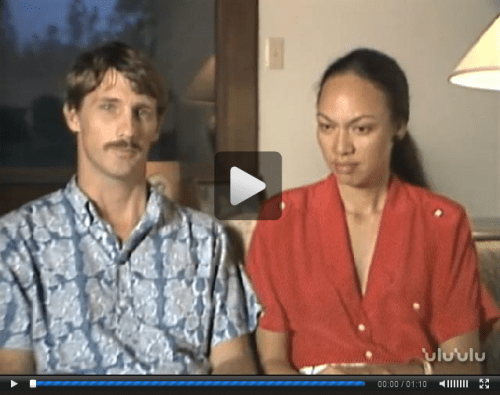
Interview with Pila Wilson and Kauanoe Kamanā

Interview with Pila Wilson and Kauanoe Kamanā in their Hilo home discussing the Pūnana Leo preschools and how they have chosen to use ‘Ōlelo Hawai‘i in their home.

E ola mau ka ‘Ōlelo Hawai‘i!

Other Online Resources:

A Timeline of Revitalization http://www.ahapunanaleo.org/index.php?/about/a_timeline_of_revitalization/

E Ola Ka ‘Ōlelo Hawai‘i (1996) – View at http://www.ahapunanaleo.org/index.php?/resources/cartoons/
“This video presentation tells the story of how a small group of scholars and native speakers struggled to bring back the language that their ancestors were forced to give up.” Produced by the ʻAha Pūnana Leo. Directed by Na Maka o ka ‘Aina. 28 minutes.

WiPC:E 2014 ~ E Mau Ana Ka Mo‘olelo

wipce_performances1

The 2014 World Indigenous Peoples Conference on Education (WiPC:E) was held last week at Kapi‘iolani Community College in Honolulu. According to the conference website, WiPC:E is “the largest venue for indigenous education in the world.” This year’s theme was E Mau Ana Ka Mo‘olelo: Our Narratives Endure. Over 3,000 people from all over the world came together “to discuss contemporary movements in education that support our unique indigenous worldviews.”

I was fortunate to have been able to volunteer at and attend the conference all week. I attended workshops presented by indigenous peoples from Canada, Aotearoa (New Zealand), and Hawai‘i and also met people from Japan, Australia, and Europe. Many of the presentations I attended focused on indigenizing the academy, but other topics included information literacy, digital storytelling, digital libraries, strengthening culture, indigenous leadership and the importance of our indigenous languages.

wipce_huakai

As part of the Huaka‘i day, I also had the pleasure of visiting Ka Waihona o ka Na‘auao public charter school in Nānākuli, not too far from ‘Ulu‘ulu. We had about twenty people from Australia, Aotearoa, the United States, and Hawai‘i in our group. As soon as we got off the bus, we were welcomed with an ‘oli aloha by haumāna at Ka Waihona. During our visit, we listened to kumu and haumāna talk about the school’s humble beginnings, its challenges and its successes. The haumāna also took some time to explain what they had learned about the kiawe trees, which are abundant on the Wai‘anae coast. Apparently, kiawe beans are edible! And, they use its beans to make energy bars which have already won awards and are now sold in restaurants in Waikīkī. The entire huaka‘i was a great learning experience and everyone in our group had nothing but good things to say on the bus ride back to Kapi‘olani Community College (view photos here).

wipce_performances4

As much fun as the huaka‘i was though, the cultural performances were my favorite parts of the conference. From the parade of nations held on Monday to the cultural presentations held throughout the conference (especially those on Thursday evening!), it was indeed a treat to be able to listen to indigenous peoples speaking their languages and to watch them doing traditional songs and dances.

Overall, I am entirely grateful that I was able to attend WiPC:E 2014. It was an awesome experience personally and professionally! Mahalo to the Conference Chairs, Lui Hokoano (UHWO) and Judy Ann Olivera (WCC), and the Organizing Committee. Special mahalo to the Huaka‘i Committee for allowing me to volunteer with your team!

Click here to check out photos of WiPC:E on our Flickr!

Post By: Shavonn Matsuda

Farewell Peter

Peter taking a pause from measuring film to share a double shaka

Peter taking a pause from measuring film to share a double shaka


Last June, we introduced you to one of our volunteers, Peter Kowen (read the post here). We are sad to announce that yesterday was Peter’s last day at ‘Ulu‘ulu. During his time here, Peter has worked diligently on the CLEAR (Center for Labor Education & Research) collection – inventorying boxes and boxes of video, film and other AV materials related to Hawai‘i’s labor history. While processing this collection, he actually came across raw video footage of an interview with his grandfather that was used as part of the 1996 documentary, 1946: The Great Hawai‘i Sugar Strike (to view the full-length streaming video, visit http://www.hawaii.edu/uhwo/clear/home/e-library.html).

Peter says he has “learned a lot about media in Hawai‘i” while working at ‘Ulu‘ulu. He will continue to pursue his profound passion for film at American University in Washington D.C. this fall where he will begin his graduate studies.

We greatly value the work you’ve done Peter and wish you all the best in your future (film) endeavors!

Mahalo and aloha,
The ‘Ulu‘ulu Staff

Mālama Honua

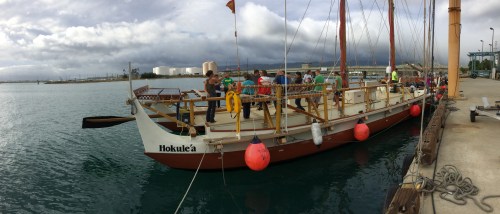
The Worldwide Voyage of Hōkūleʻa and Hikianalia is scheduled to depart Oʻahu for Hilo on May 17th, weather permitting. From Hilo, the sister canoes will sail to Tahiti, and begin their international journey.

Educators from around the island attended yesterday’s WWV Educational Summit which was led by crew members Jenna Ishii, Patricia Halagao and Miki Tomita. ʻUluʻulu is proud & honored to play a role in supporting the education effort of this very important voyage. We were invited to introduce our Theme Page to educators who will be creating curriculum and connecting with the crew via satellite.

Connect to www.hokulea.org and follow the plan for Mālama Honua through 2017!

Click on the image below to view more images:
Hōkūle'a