Oceania Rising

Last Friday, Oceania Rising took place at Kamakakūokalani: Center for Hawaiian Studies to remember and observe the 59th anniversary of the bombing of Bikini Atoll and reconnect Pacific peoples for peace. On March 1, 1954 the U.S. military dropped a nuclear bomb larger than the bombs dropped on Nagasaki and Hiroshima. The fallout affected the surrounding islands and peoples. Two decades later Hawaiians and supporters fought for and were successful in stopping the bombing of Kahoʻolawe, a sacred island used historically for navigation. Around this time people from around the Pacific were linking up with each other and making connections with what was going on in their islands. One group which formed out of this linking was Nuclear Free Pacific (NFP), which later added an I for Independent (NFIP). NFIP was a convergence of Pacific Peoples and their supporters to stop the  bombing of the Pacific and work towards peace. Oceania Rising was a day of remembrance, reflection, and reconnection! Below are clips related to peace movements in Hawaiʻi and around the Pacific.
nuclear_free_727

A Nuclear Free Pacific? Victoria Keith Productions (1980)

The 1980 Nuclear-Free Pacific conference took place in Hawaiʻi.  As noted above this was a convergence of people from Hawaiʻi, Tahiti, Japan, and all over the Pacific to discuss and organize towards disarmament. The documentary includes speeches and interviews with members of NFP as well as footage of the No Nukes Concert which took place at Andrews Amphitheatre on the UH Mānoa Campus. Featured in the clip is Graham Nash of Crosby, Stills, & Nash and Olomana and Kawaikapuokalani Frank Hewett.
RIMPAC '82. Nā Maka o ka ʻĀina.

RIMPAC ’82. HKG Pilot Project: Nā Maka o ka ʻĀina.

Produced by Nā Maka o ka ʻĀina in 1982, this program is a compilation of footage dealing with the Protect Kahoʻolawe ʻOhana’s 1982 campaign to stop RIMPAC — Rim of the Pacific military exercises, part of which included the bombing of Kahoʻolawe island. Speeches and musical presentations from the March 6, 1982 Tribute to George Helm and Kimo Mitchell at ʻIolani Palace are intercut with footage of ʻOhana activities, news coverage of demonstrations and photos/narration from the PKO’s educational slideshow, narrated by Luana Busby. This video was digitally remastered/archived in 2011 by Joan Lander and Puhipau of Nā Maka o ka ʻĀina with support from Hawaiʻi People’s Fund.

By Koa Luke

AHA Conference: Practical Stewardship of Collections

On Saturday Feb 16, the Association of Hawaiʻi Archivists (AHA) held their annual conference. This year the conference focused on Practical Stewardship of Collections “informed by the findings of the 2010 HMA Connecting to Collections Survey which identified practical collections care training as one of the primary needs of local cultural heritage institutions.” There were several panels and speakers talking on a variety of topics from the importance of working with the community when culturally sensitive items are on display, the preservation of metal and paper, climate and pest control, to caring for textiles in your collection.

Practical stewardship is something that ‘Ulu‘ulu is highly concerned with as part of our mission is the preservation of film and videotape related to the history and culture of Native Hawaiians and the people of Hawai‘i. During lunch, Janel Quirante and Koa Luke recapped work accomplished since last year’s conference and shared the Highlight Reel below of recently digitized footage.  It was a great experience! — By Koa Luke

This video footage may be protected under U.S. copyright law and is provided for educational and research purposes only.

Volcanic Footage to Heat Up Your Valentine’s Day

Image

Using the search feature (magnifying glass symbol) at the top of the Uluulu website, we selected a few volcano clips to highlight today. You will find that the search bar is a great portal for discovering many of the videos in our collection. Give it a try! You might be surprised at what you find…

Screen shot 2013-02-14 at 1.42.58 PM

 Volcano Footage- Ted Shibuya

Tip of the day: Using truncation in the search bar can yield more results for your search. Example: Instead of searching for “volcano” or “volcanos” or “volcanic”, try searching: “volcan*

Our truncation symbol is the asterisk  (*).

Screen shot 2013-02-14 at 2.48.27 PM

Many associate volcanic activity with the Hawaiian Islands, but, for the majority who live here, it is not an everyday event to witness such a spectacle. What is amazing about the footage, above & below, is, beyond its age of over 50 years, the film still offers us the rare glimpse of what it is like to be so close in proximity to a live active volcano. One can’t help wonder what might have been going through minds of the people who risked, not only their expensive film equipment, but their own lives to capture impending lava flows. Fortunately for us, thanks to these brave filmmakers and to those who believed it was necessary to preserve their films,  researchers, scientists, and volcano enthusiasts are able watch & enjoy what they have left as their legacy.

Screen shot 2013-02-14 at 1.36.36 PM1955 Kapoho Eruption – Lyman Museum


Screen shot 2013-02-14 at 1.37.17 PM

Kīlauea Iki Eruption, 1959 – Lyman Museum

Screen shot 2013-02-14 at 1.37.00 PM

Kīlauea Iki Eruption, 1959, HIPA (Hawaii Island Planters Asssociation) – Lyman Museum

Enjoy the volcano footage and Happy Valentines Day! —By Robbie O.

New clips: On Location

Three newly digitized clips from the KGMB Electronic News Gathering (ENG) files have just been added to our website. ENG footage was shot on location by news camera teams to be later edited into broadcast news stories. These three ENG clips are from 1980, an interesting time in Hawaiʻiʻs rich cultural and political history. Each KGMB ENG file in our collection includes several unedited stories along with a timecoded shot list.

eng130_1749

ENG news file (October 1980). KGMB collection.

Clip includes Gabby Pahinuiʻs funeral, Office of Hawaiian Affairs, Tahitian dancing, and bagpipes in Hawaiʻi.

eng134_1750

ENG news file (November 1980). KGMB collection

Clip includes community meetings about designating sites on Kahoʻolawe as national registered sites, Protect Kahoʻolawe, Harry Kunihi Mitchell, KITV labor strikes, and historical Hawaiʻi paintings.

eng138_1751

ENG news file (November 1980). KGMB collection

Clip includes Sol Bright Sr. singing and dancing and talking story about his song “Hawaiian Cowboy.”

Hawaiian food

This past week the quality of Hawaiʻi’s food has been a topic of national news. Saying that Hawaiʻi has subpar food is overlooking the many ʻono delicacies that make Hawaiʻi unique to the world. Hawaiʻi has been in front of the eat local food movement and as we move forward in the 21st century the local food industry is an example of how our economy can be strengthened. Here are some clips in our collection related to Hawaiian food.

hailis_703

Haili’s Hawaiian Foods (1986). Juniroa Productions collection.

Haili’s Hawaiian Foods has been a local favorite for decades and is one of the few Hawaiian-owned Hawaiian food restaurants. Here the workers explain how that ʻono food is prepared.

bread_624

Portuguese bread making (1971). HKG Pilot Project: Lyman Museum.

In the later part of the 19th century, workers were brought over from Portugal as one of the many nationalities to work on the sugar plantations. Along with bringing instruments that would evolve into the ʻukulele, the Portuguese brought with them their delicious sweet bread.  Here is a clip from the Lyman Museum and Pilot Project of how it’s prepared.

kaluapig_552

Kālua pig and imu. HKG Pilot Project: Lānaʻi Culture and Heritage Center.

For Hawaiians, food is an important aspect of social life. In traditional times the land, sea, plant and animals were kinolau (forms) of gods and ancestors, therefore producing and eating certain foods was a way of communing with them. In this clip, local Lānaʻi residents prepare a pig in an imu.  An imu is a traditional oven where a hole is dug and heated rocks are placed inside. After the rocks are heated, plants or animals are placed on the rocks and covered with leaves, and left to cook for hours. Here the people place a pig inside which will result in Kalua pig which is similar to pulled pork in texture, but not in taste.    —By Koa Luke

Two Green Valleys screening

On Thursday January 24, Hawaiʻi People’s Fund held an event called Kīpuka For Change: Building Solidarity to Protect the ʻĀina. The event brought people from Hawaiʻi’s diverse communities together to network and share opinions and ideas. Kīpuka are areas of vegetation growth in a lava flow or a calm water in rough seas. Used in this context, the kaona (hidden meaning) of kīpuka is people coming together to create pockets of change.

The event included a screening of Victoria Keith’s Two Green Valleys (1976) which documents eviction protests in Waiāhole/Waikāne. In the 1970s the residents of Waiāhole/Waikāne on the windward side learned that the landowner had planned to evict them and build new condominiums. The local residents, realizing that this would drastically change their way of life, organized to stop the project from moving forward. This formed a diverse movement of Hawaiians, locals, and students from the university which was successful in halting the project.

Stories like Two Green Valleys help us remember Hawaiʻi’s rich history of social justice. — By Koa Luke

2greenvalleys

The original 1/2″ EIAJ master videotape of Two Green Valleys was preserved and digitized as part of ‘Ulu‘ulu’s Pilot Project.

2greenvalleys_714

Two Green Valleys (1976). Victoria Keith Productions

waiahole

Waiāhole / Waikāne March. Victoria Keith Productions

waiahole_590

Waiāhole / Waikāne Rally. Nā Maka o ka ʻĀina

Civil rights and social activism in Hawai‘i

On Monday January 21, Hawai‘i took a holiday to remember the contributions to human rights made by Martin Luther King Jr. King was a civil rights pioneer, anti-war activist, and an advocate of civil disobedience. In the 1960s and 1970s Hawai‘i saw a rise in social activism, human rights advocacy, and a re-emergence of Hawaiian activism. The organizing ranged around a variety of issues from housing, labor, militarism, and land issues and was deeply inspired by King and other civil rights activists. Here are a few clips that highlight this rich history.

h3_733

Hālawa Coalition Protest. Kamakakūokalani Center for Hawaiian Studies, HKG Pilot Project collection.

In the late 1980s the state began building the H-3 freeway which connected windward and central O‘ahu.  Dubbed by critics as an artery to link up military bases, many people opposed the project because it ran through Hālawa Valley where many heiau (sacred site of worship) and Hawaiian burials are located. This video documents some of the actions Hawaiians and their supporters took to protect the valley.

helm_591

Kahoʻolawe Aloha ʻĀina. Nā Maka o ka ʻĀina, HKG Pilot Project collection.

Important in the re-emergence of Hawaiian activism was a reclamation of ‘āina (land) and identity. The Kaho‘olawe protests were as much about stopping the bombing of sacred ‘āina as they were about reclaiming an Hawaiian Identity and the concept of aloha ‘āina (love for the land) which moved the people to occupation of the land. After much protest and occupations the Navy stopped the bombing and gave the island to the state of Hawai‘i until a Hawaiian entity is created. George Helm led this struggle and connected to people, young and old. Helm and the island remain an example of aloha ‘āina. “Produced by Walter Ritte in 1976, this video portrays the earliest days of the movement to stop the bombing of Kahoʻolawe through peaceful occupations of the island, public testimony, litigation, music, hula, and public education.”

By Koa Luke


Anniversary of the Overthrow of the Kingdom of Hawai‘i

January 17th is an historic day for many in Hawaiʻi as it marks the 120th anniversary of the overthrow of the Hawaiian Kingdom.  On January 17 1893, 13 men, with the help of the United States Marines, overtook the Palace and imprisoned the Queen.  President Cleveland proclaimed that this was an act of war on the part of the United States and that it needed to be corrected.  However, Hawaiʻi was annexed through domestic law during President McKinley’s term and the Spanish-American War.  This is a sad day for many and a day not to forget for all.  Below are clips related to Hawaiian Sovereignty and the Overthrow.

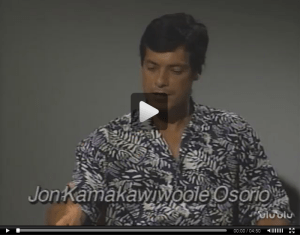
Jon Osorio, First Friday

Kamakakūokalani Center for Hawaiian Studies, HKG Pilot Project Collection

Jon Osorio appears on First Friday to explain Hawaiian history from the Bayonet Constitution to the overthrow.  In this clip he discusses the Bayonet Constitutions which King Kalākaua was forced to sign under duress.  The constitution disenfranchised many Native Hawaiians and Non Native citizens.

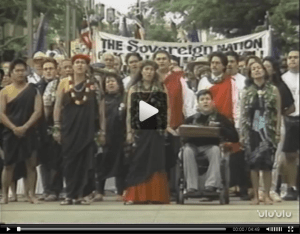
Hawaiian Rights March, First Friday

Kamakakūokalani Center for Hawaiian Studies, HKG Pilot Project Collection

The 1970s and 1980s saw a re-emergence of Hawaiian Culture and activism for Hawaiian Rights and Sovereignty.  Protests and land occupations were happening around the islands which developed into the formation of Hawaiian organizations.  On the 100th anniversary of the overthrow, the largest demonstration and march in the history of Hawaiʻi took place at the Palace. Hawaiians and supporters gathered to assert their rights at this historic and political site.  This episode of First Friday features clips from the march and participants from Ka Lāhui o Hawaiʻi, one of the largest sovereignty groups in the islands.

Posted by Koa Luke

Aloha, Senator Inouye

‘Ulu‘ulu is saddened by the passing of U.S. Senator Daniel K. Inouye and we extend our sincerest condolences to his family.

Senator Inouye was always a true champion and supporter of ‘Ulu‘ulu’s mission to preserve and share Hawaii’s moving image history. He was instrumental in the foundation of our archive and his efforts helped secure the first three years of Federal funding for what has become the first moving image archive in the state.

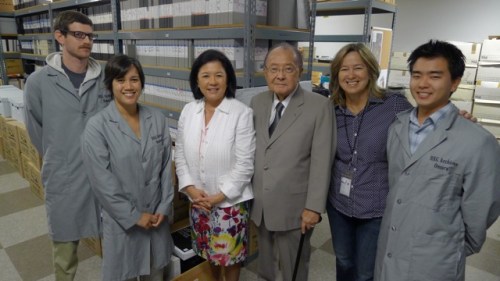
Senator Inouye’s presence is felt daily in our archive, as images of him through the years with his long-time friend and aide Henry Ku‘ualoha Giugni line our walls. We will miss him greatly.

Aloha, Senator Inouye!

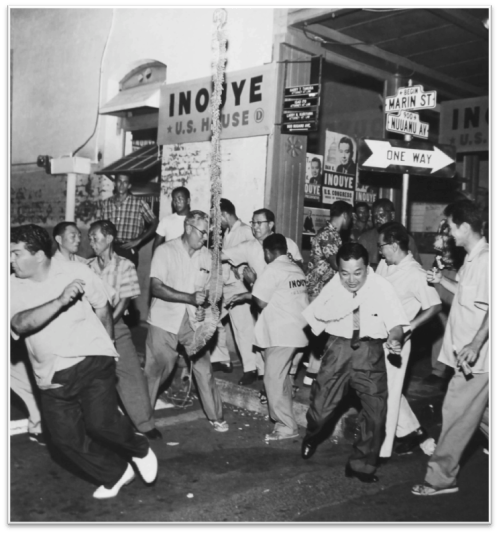
inouye1959

Celebration at Inouye’s campaign headquarters on his election to the U.S. House of Representatives, 1959.

inouye_1392

Speech to The Chamber of Commerce of Hawaiʻi, 1998. Juniroa Productions collection.

inouye_1398

Medal of Honor Ceremony, 2000. Juniroa Productions collection.

P1030424

Senator Inouye visits ‘Ulu‘ulu, August 2011.

Happy Holidays!

Christmas came early to ‘Ulu‘ulu this year as we’ve recently acquired the KITV Collection which includes programming and news footage of events like the Merrie Monarch Festival and specials like The Don Ho Christmas Show.

The Don Ho Christmas Show (1967), KITV Collection

The Don Ho Christmas Show (1967), KITV Collection

Preserving and archiving this footage is important because it informs future generations and researchers about trends and cultural and political events from different time periods in Hawaiʻi. We are excited to have this material in our collection.

The archives will be closed during the UH West Oahu Winter Break starting December 17 and will reopen on January 2, 2013.

Whatever your ʻohana’s traditions — Happy Holidays from the ‘Ulu‘ulu crew!

happy holidays 2012 small